
CTET 2026 Exam Pattern Explained: Paper 1 & 2 Questions, Marks and Time
| Organization Name | National Testing Agency (NTA) |
| Recruitment Organization | Central Board of Secondary Education (CBSE) |
| Exam Name | Central Teacher Eligibility Test (CTET) 2026 |
| Total Vacancies | 0 |
| Application Mode | Online |
| Eligibility Notes | This article covers the examination pattern rather than the complete CTET eligibility criteria. Candidates should refer to the applicable official information bulletin for qualification and other eligibility requirements. |
- Step 1: Choose the applicable CTET paper according to the intended teaching level and eligibility requirements.
- Step 2: Appear for Paper 1, Paper 2, or both papers as applicable.
- Step 3: Attempt the 150 multiple-choice questions within the allotted 150-minute duration.
- Step 4: Use the applicable CTET result and qualifying criteria to determine eligibility for teacher recruitment processes.
- Step 1: Check the applicable CTET information bulletin and confirm your eligibility before applying.
- Step 2: Visit the official CTET application portal when the relevant application window is open.
- Step 3: Complete registration and enter the required personal, academic and examination details.
- Step 4: Select Paper 1, Paper 2, or both according to your eligibility and intended teaching level.
- Step 5: Submit the application after checking all details and retain the confirmation for future reference.
| Subject Name | Questions | Marks | Topics List (Comma Separated) |
|---|---|---|---|
| Child Development and Pedagogy | 30 | 30 |
Child development•
Learning and pedagogy•
Understanding diverse learners•
Teaching-learning processes
|
| Language I | 30 | 30 |
Language comprehension•
Language development pedagogy•
Reading comprehension•
Teaching language skills
|
| Language II | 30 | 30 |
Comprehension•
Language pedagogy•
Communication skills•
Language learning processes
|
| Mathematics | 30 | 30 |
Number concepts•
Arithmetic concepts•
Geometry•
Measurement•
Mathematics pedagogy
|
| Environmental Studies | 30 | 30 |
Family and relationships•
Food and shelter•
Water and travel•
Things we make and do•
Environmental Studies pedagogy
|
| Subject Name | Questions | Marks | Topics List (Comma Separated) |
|---|---|---|---|
| Child Development and Pedagogy | 30 | 30 |
Child development•
Learning and pedagogy•
Individual differences•
Inclusive education
|
| Language I | 30 | 30 |
Comprehension•
Language development•
Language pedagogy•
Teaching-learning materials
|
| Language II | 30 | 30 |
Reading comprehension•
Language learning•
Pedagogical approaches•
Communication and language skills
|
| Mathematics and Science OR Social Studies/Social Science | 60 | 60 |
Mathematics concepts and pedagogy•
Science concepts and pedagogy•
Social Studies/Social Science concepts•
Subject-specific teaching methods
|
| Link Description | Action Link |
|---|
CTET 2026 Exam Pattern
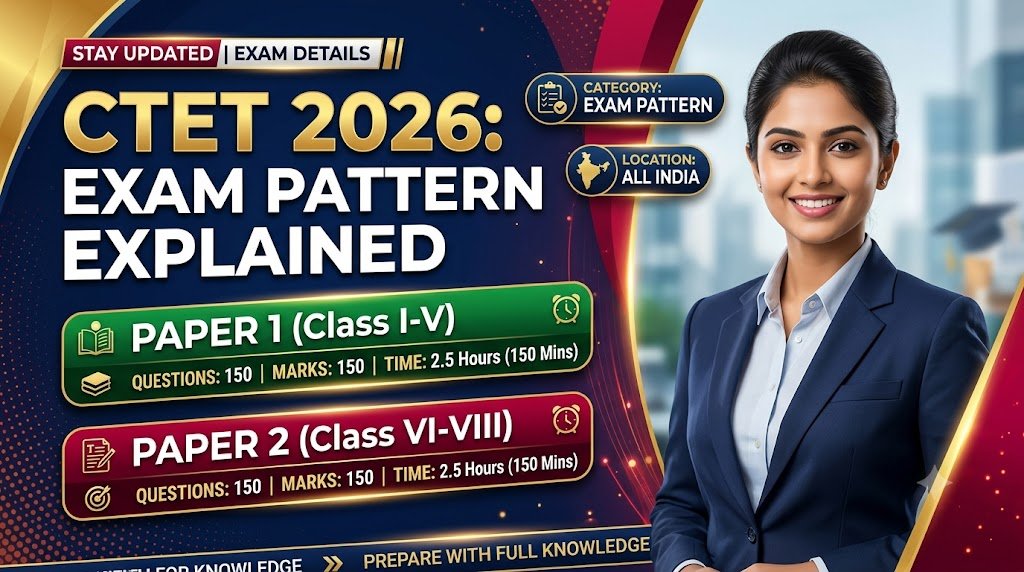
The Central Teacher Eligibility Test (CTET) is conducted by the Central Board of Secondary Education (CBSE) for candidates seeking eligibility to teach at the primary and elementary levels. The examination is divided into two papers. Paper 1 is designed for candidates intending to teach Classes 1 to 5, while Paper 2 is meant for teaching Classes 6 to 8. Candidates who want eligibility for both levels may appear for both papers, subject to the prescribed eligibility conditions.
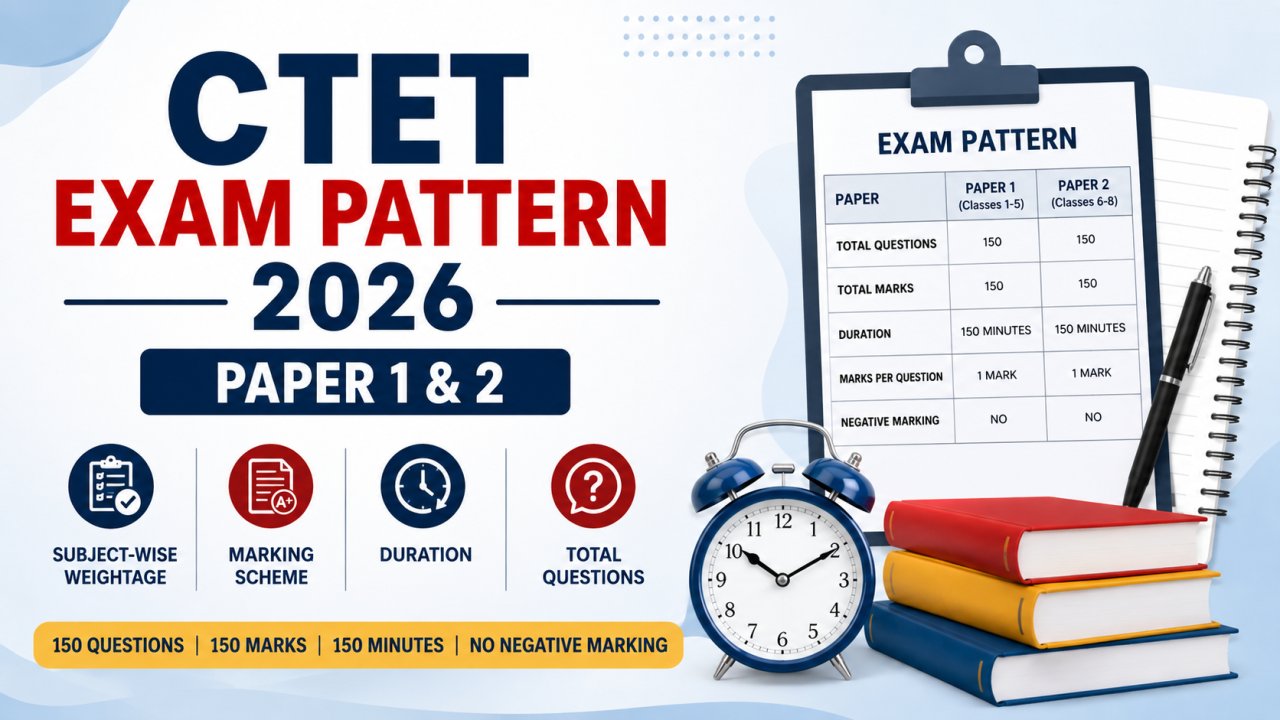
Each CTET paper contains 150 multiple-choice questions and carries a maximum of 150 marks. One mark is awarded for every correct response. There is no negative marking, so an incorrect answer does not reduce the candidate's score. The allotted time for each paper is 150 minutes, or two hours and thirty minutes.
CTET Paper 1 Pattern
Paper 1 is intended for the primary teaching level. It contains five sections with an equal distribution of questions and marks. Child Development and Pedagogy, Language I, Language II, Mathematics and Environmental Studies each contain 30 questions. Every section contributes 30 marks, resulting in 150 questions for 150 marks.
Because all five sections carry the same share of the paper, candidates should maintain balanced preparation. Child Development and Pedagogy focuses on learners and teaching principles, while Mathematics and Environmental Studies cover concepts relevant to the primary stage. The two language sections assess language comprehension and pedagogical understanding.
CTET Paper 2 Pattern
Paper 2 is intended for the Classes 6 to 8 teaching level. The first three sections are Child Development and Pedagogy, Language I and Language II, with 30 questions and 30 marks each. The remaining 60 questions carry 60 marks and are based on the candidate's selected subject option: Mathematics and Science or Social Studies/Social Science.
The 60-mark subject section therefore has the largest share of Paper 2. Candidates should select the applicable subject option according to the teaching area and eligibility requirements and prepare the relevant concepts and pedagogy thoroughly.
CTET Marking Scheme
The marking system is straightforward. Every correct response earns one mark. There is no penalty for an incorrect response, and an unanswered question receives zero marks. Since there is no negative marking, candidates can attempt questions when they are reasonably confident or use the available time to make educated attempts after completing the questions they know well.
CTET Exam Duration
Both Paper 1 and Paper 2 are scheduled for 150 minutes. With 150 questions in each paper, candidates should develop a practical time-management strategy before the examination. A useful approach is to move steadily through easier questions first, avoid spending excessive time on a single question and reserve a few minutes for reviewing marked responses.
Paper 1 and Paper 2: Key Difference
The most important difference is the teaching level and subject structure. Paper 1 targets Classes 1 to 5 and includes Environmental Studies as its fifth section. Paper 2 targets Classes 6 to 8 and replaces that structure with a 60-question subject block covering Mathematics and Science or Social Studies/Social Science. Both papers have the same total number of questions, total marks and duration.
Preparation Strategy
Understanding the pattern should be the starting point of preparation rather than the final step. Candidates should divide their study schedule according to the number of questions and marks assigned to each section. Regular practice with multiple-choice questions can improve speed and accuracy. For Paper 1, equal attention should be given to all five sections. For Paper 2, candidates should also devote substantial preparation time to the 60-mark subject section because it represents the largest individual component of the paper.
Before appearing for CTET, candidates should also check the latest official examination information, language options, eligibility conditions and instructions issued for the relevant session. The exam pattern provided here is based on the supplied 2026 pattern details and should be used alongside the applicable official notification or information bulletin.
No comments yet. Be the first to join the discussion!